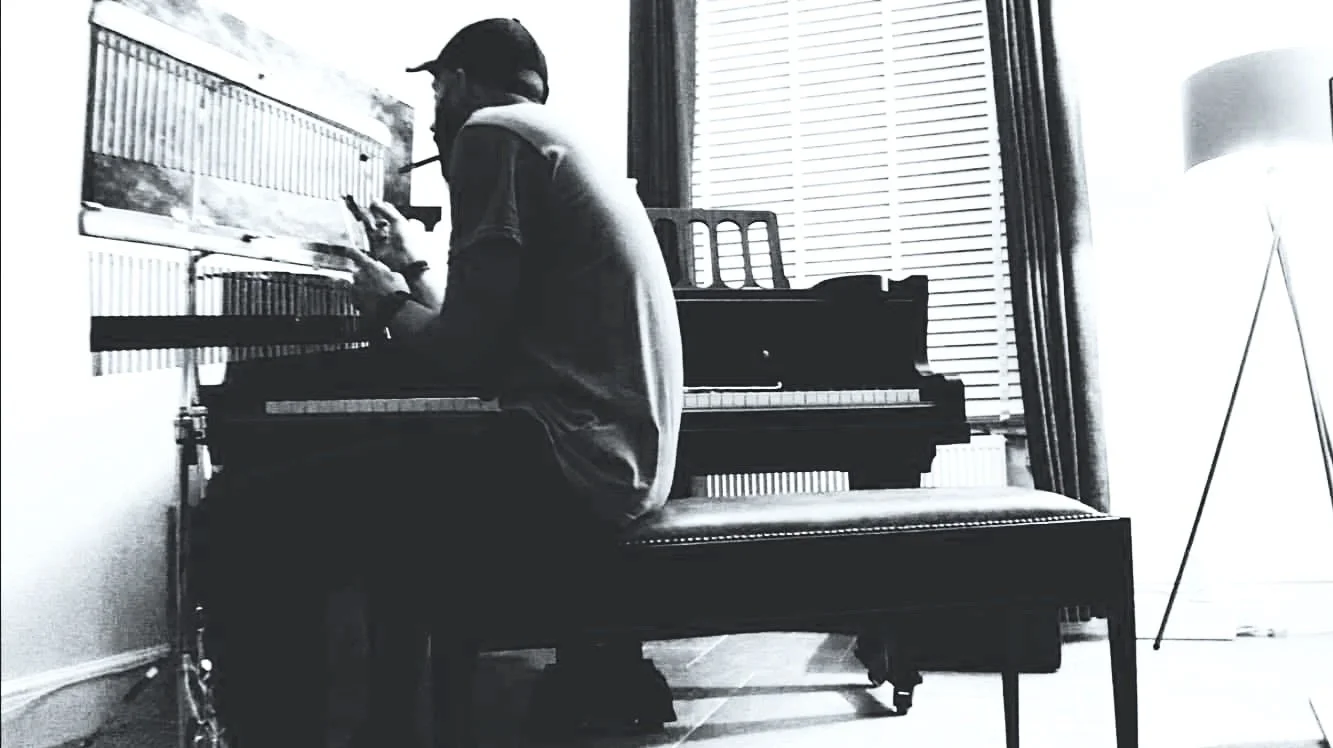
“...The sublime alchemy of Canary Island’s native Rubens Askenar reframes the possibilities of the piano” - Mata Festival (New York)
“...This is music that appeals to the most primitive instincts and manages to show that it is possible to create authentic wonders with non-normative elements” - Núvol Magazine (Barcelona)
“…broad musical knowledge put into practice with insight, judgment and good manners. A final anticlimax rounded the overwhelming sound image displayed” - Forum Clásico Magazine (Madrid)
Dr. Rubens Askenar is a Canarian composer and researcher based in London. His work explores composition as a field of interacting systems, situated between instrumental practice, experimental technologies, and nonlinear dynamics, with particular attention to feedback, instability, and emergent sonic behaviour.
Working across acoustic, electroacoustic, and hybrid contexts, Askenar develops compositional models grounded in hands-on, multi-instrumental practice. Instruments, performers, and electronic processes are treated not as fixed units but as interdependent feedback structures-layered, staged, and superposed across distinct sonic domains. Within these networks, musical behaviour emerges through internal and external recursions rather than linear causality.
His music has been presented internationally at venues and festivals including the Muziekgebouw (Netherlands), reMusic (Russia), FIMC (Spain), and the MATA Festival (New York). Across these contexts, his work often unfolds as a constellation of semi-autonomous sonic organisms: feedback conglomerates whose interactions generate shifting hierarchies of spectral, temporal, and spatial relations. These interactions produce evolving gradients of resonance and instability, giving rise to forms of meta-feedback, feedback between feedbacks, where distinctions between signal, control, and noise become porous.
A committed performer and multi-instrumentalist, Askenar’s compositional thinking is fundamentally material and process-driven. His practice foregrounds vibration, resonance, and nonlinear behaviour as primary musical forces, frequently engaging with chaotic modulation and unstable control systems as compositional resources.
Alongside his compositional work, Askenar develops frameworks for live composition, designing systems that enable real-time interaction between composers, performers, ensembles, and orchestras. Through this work, he continues to interrogate authorship, agency, and form in contemporary music-making.
SUPERVISION
Alongside his compositional practice, Askenar teaches one-to-one composition and orchestration at the Royal Academy of Music. He also supervises and examines PhD research in Composition as primary supervisor at both the Royal Academy of Music and the Royal College of Music. Supervised research areas include orchestration models involving inexact pitch notation, the relationship between technology, timbre, and orchestration, the influence of electronic systems on orchestral practice, and spectro-morphological approaches to composition.
Askenar accepts a limited number of private mentees each year. More on mentorship →
SELECTED PUBLICATIONS
A catalogue of selected published compositions can be found at Composers Edition
Askenar, R., Lessons on Disremembering. Models of Sound Creation. Colección Canora II. Ateneo de La Laguna, 2023